
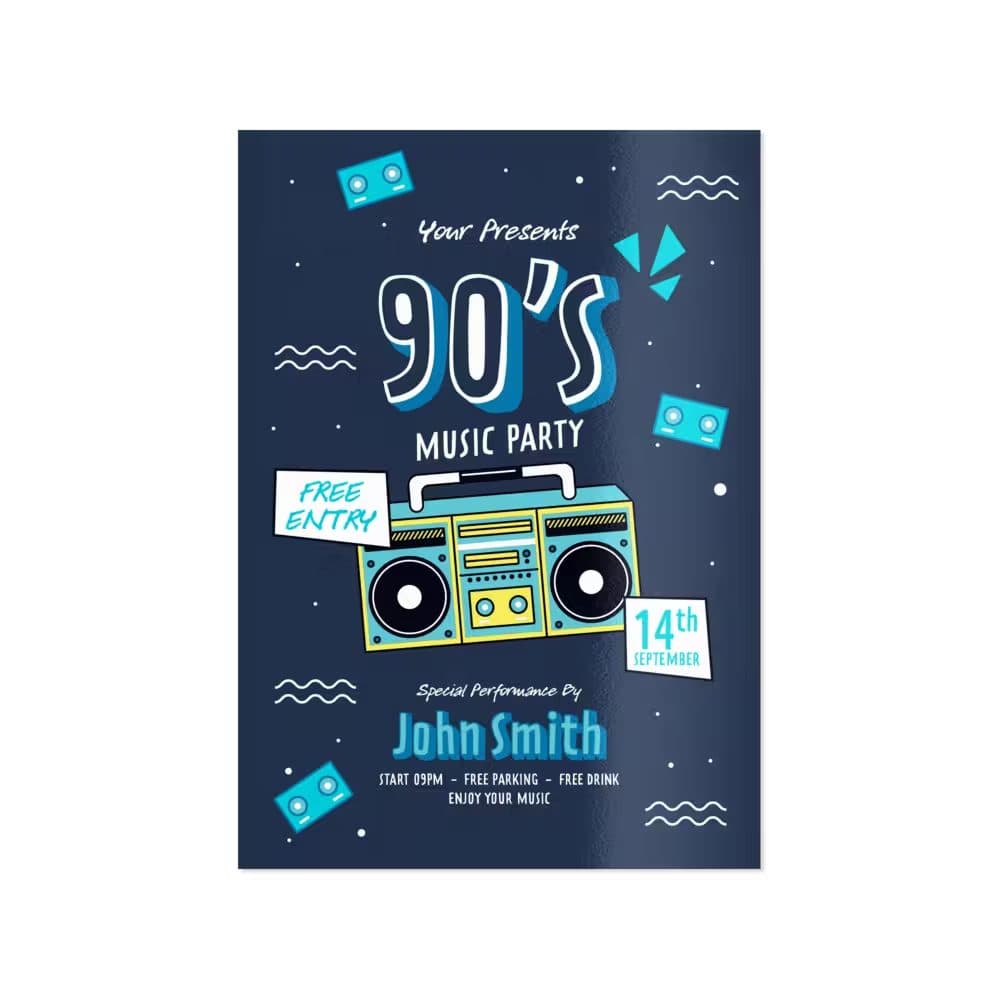
Examples of work we've printed. We send a digital proof of your artwork before anything goes to press.
Posters
Big, bold, and built to be seen.
Printed in high-resolution full colour on uncoated, matte, gloss or synthetic stock.
A3 is the size we run, and it covers most of what a poster is actually for: in-store, on a noticeboard, in a frame, at an event.
Synthetic is waterproof and antibacterial. Uncoated takes a pen or a stamp; matte and gloss won't. There's a guide to all of them further down this page.
Uncoated runs 100, 250 or 350gsm. No coating at all, so it takes a pen or a stamp.
A3 is the poster size we run. Anything larger is large format, which is signage rather than print - there's a route for that at the bottom of this page.
Optional. Skip it and we'll ask later. Setup sizes and file requirements are further down this page.
Quoted to your spec, quantity and deadline.
Choosing a stock
Which stock, and why it matters
Four stocks, and the choice matters more than the weight. What changes is how the poster hangs, whether you can write on it, and whether it survives where it is going.
Uncoated
No coating at all. 100, 250 or 350gsm.
SuitsAnything with a tear-off, a roster or a sign-up sheet on it.
Matte
Coated, low sheen. 128 to 250gsm.
SuitsText-heavy notices, and anything read up close under lights.
Gloss
Coated, with a sheen. 128 to 250gsm.
SuitsImage-led posters where the photography is doing the work.
Synthetic
Waterproof and antibacterial. 190, 261 or 368gsm.
SuitsOutdoors, in a wet room, or anywhere a paper poster would curl or tear.
Every stock above runs to the same turnaround, so a heavier or tougher one never costs you time. Within a stock, the weight changes how substantial it feels rather than how it prints. Still deciding? Tell us what it's for and where it's going and we'll say which way to go.
Turnaround & delivery
Every one of these runs from artwork approval, not from when you place the order.
- Priority
- 3–5 business days
- Standard
- 5–7 business days
These are typical rather than a ceiling, and every date is confirmed before you commit. Plenty of jobs move faster. If you are working to a deadline, tell us early and we'll tell you straight away whether it's achievable.
Collect from 2/137 Canberra Avenue, Fyshwick, Mon to Fri 8:00am–4:30pm. Or we ship anywhere in Australia, with freight quoted alongside your order.
Artwork requirements
Most production delays start here. Two minutes of reading saves a week.
| Size | Trim | Set up at (3mm bleed) | Keep content inside |
|---|---|---|---|
| A3 | 297 x 420mm | 303 x 426mm | 287 x 410mm |
- Print-ready PDF with 3mm bleed on every edge
- Fonts outlined or embedded so they don't substitute on our end
- CMYK, not RGB screen colours don't survive the press unchanged
- 300 dpi minimum at final size sharp at 5cm isn't sharp at 50cm
- Keep important content 5mm inside the trim so nothing critical gets cut
- Send Pantone references if brand colour is critical, and we'll get as close as CMYK allows
Start from our template
Print-ready PDFs set up at the right size with the bleed, trim and safe area already marked. Open one in Illustrator, InDesign or Affinity, drop your design in, and export.
Not sure? Send what you have. Our in-house design team checks every file before it goes to press and we'll tell you if something needs fixing before it costs you a reprint. Artwork preparation is quoted separately, and you'll never get a surprise line item.
Common questions
What size are your posters?
A3, which is 297 x 420mm. That's the poster size we run. Anything larger is large format, which is a different press - tell us the finished size and where it's going and we'll quote it as signage.
Which stock weight should I choose?
Pick the stock first, because it sets which weights exist. Uncoated runs 100, 250 or 350gsm and is the one you can write on. Matte and gloss run 128 to 250gsm - 170 holds itself flat against a wall and resists curling, and 250 stands on its own in a frame or on an easel. Synthetic runs 190, 261 or 368gsm and is waterproof, so it is the answer for anywhere a paper poster would curl or tear.
Can I put them outside?
These are paper posters, made for indoors. Anything facing weather, a footpath or a worksite wants corflute, vinyl or a laminate instead. Tell us where it's going and we'll match the material to the spot rather than sell you something that won't last.
Which stock should I choose?
Uncoated has no coating at all, so it takes a pen or a stamp - useful for anything with a tear-off, a roster or a sign-up sheet. Matte is easier to read under lights. Gloss lifts photography and colour. Synthetic is waterproof and antibacterial, and it is what to ask for if the poster is going somewhere damp or exposed.
What resolution does my artwork need to be?
300 dpi at final size. An image that's sharp at 5cm isn't sharp at 50cm - that's a maths problem, not a quality one.
How long do posters take?
Priority is 3–5 business days and standard is 5–7, both from artwork approval. Those are typical rather than a ceiling, and we confirm the date before you commit. If you are working to a deadline, tell us early and we will tell you straight away whether it is achievable.
Anything else
Something outside the standard spec?
A3 on paper covers most of what a poster is for. Once it gets bigger, or goes outside, it stops being print and becomes signage.
Bigger than A3
A2, A1, A0 and beyond are large format, which is a different press and a different conversation. Tell us the finished size and where it's going and we'll quote it.
Somewhere it'll get wet or knocked
These are paper posters, made for indoors. Anything facing weather, a footpath or a worksite wants corflute, vinyl or a laminate instead. Tell us the location and we'll match the material to it.
A stock that isn't listed
The stocks above are what we run as standard. Recycled, textured and heavier boards are all possible - tell us what you're after and we'll tell you what it changes.
Tell us the date. We'll tell you how it's possible.
Most quotes come back the same business day. Give us quantity, branding and deadline, and we can usually map out a way to get there.