
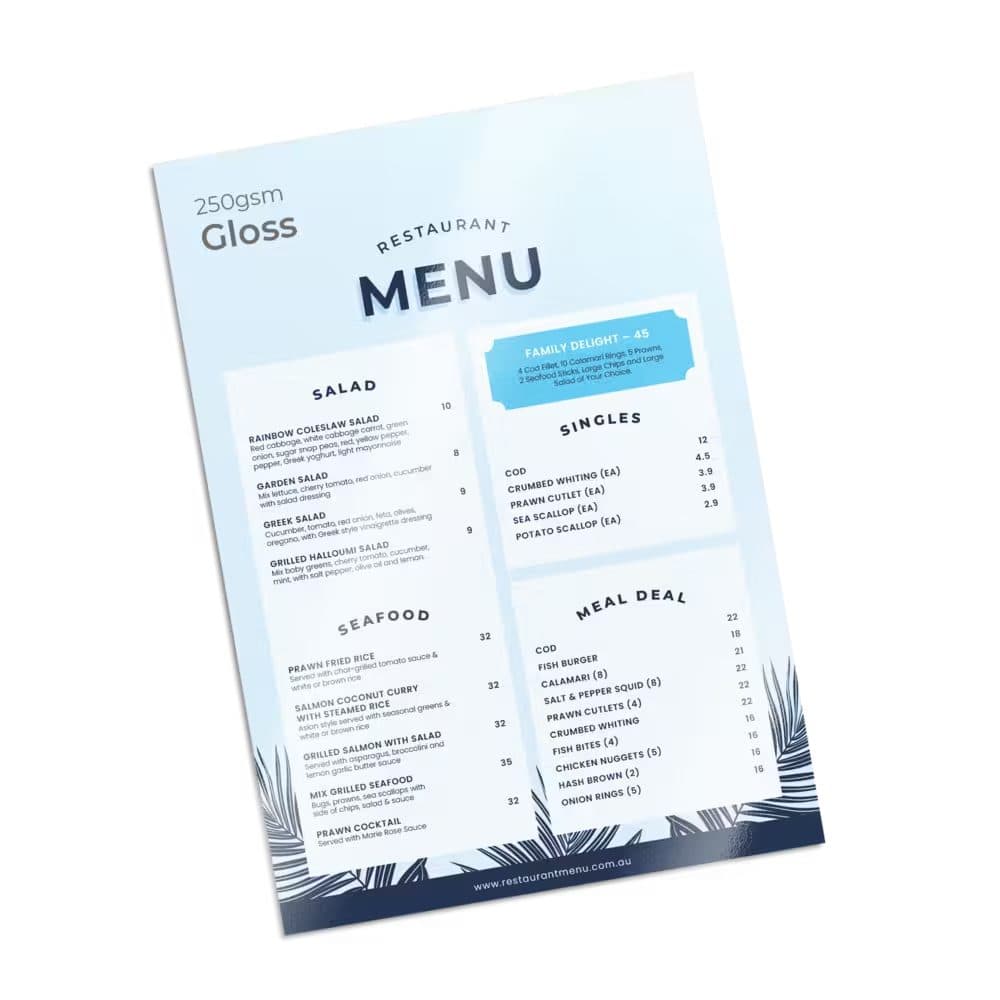
Examples of work we've printed. We send a digital proof of your artwork before anything goes to press.
Menus
Printed for daily use or seasonal change, on stock that survives being handled.
A menu is a flyer or a brochure that has to survive a service. Same flat sizes and folds, printed in full colour, with one stock built for exactly this: synthetic, which is waterproof and antibacterial.
Menus get handled hundreds of times a week, so the weight matters as much as the print. Tell us how often it changes and we'll point you at the right one.
Synthetic is waterproof and antibacterial. Uncoated takes a pen or a stamp; matte and gloss won't. There's a guide to all of them further down this page.
Uncoated runs 100, 250 or 350gsm. No coating at all, so it takes a pen or a stamp.
Flat sizes print as a single sheet. Folded sizes are printed flat and folded after, and the sheet they come off is in brackets.
Optional. Skip it and we'll ask later. Setup sizes and file requirements are further down this page.
Quoted to your spec, quantity and deadline.
Choosing a stock
Which stock, and why it matters
Four stocks, and on a menu this is the decision that matters. What changes is whether it survives a service.
Uncoated
No coating at all. 100, 250 or 350gsm.
SuitsMenus written on, and anything replaced often enough that durability is not the point.
Matte
Coated, low sheen. 128 to 250gsm.
SuitsText-heavy menus, wine lists, anything read at length under low light.
Gloss
Coated, with a sheen. 128 to 250gsm.
SuitsMenus leading with photography.
Synthetic
Waterproof and antibacterial. 190, 261 or 368gsm.
SuitsThe one to ask about for a table menu. Waterproof and antibacterial, so it wipes down between covers instead of being reprinted.
Every stock above runs to the same turnaround, so a heavier or tougher one never costs you time. Within a stock, the weight changes how substantial it feels rather than how it prints. Still deciding? Tell us what it's for and where it's going and we'll say which way to go.
Turnaround & delivery
Every one of these runs from artwork approval, not from when you place the order.
- Priority
- 3–5 business days
- Standard
- 5–7 business days
These are typical rather than a ceiling, and every date is confirmed before you commit. Plenty of jobs move faster. If you are working to a deadline, tell us early and we'll tell you straight away whether it's achievable.
Collect from 2/137 Canberra Avenue, Fyshwick, Mon to Fri 8:00am–4:30pm. Or we ship anywhere in Australia, with freight quoted alongside your order.
Artwork requirements
Most production delays start here. Two minutes of reading saves a week.
| Size | Trim | Set up at (3mm bleed) | Keep content inside |
|---|---|---|---|
| A6 flat | 105 x 148mm | 111 x 154mm | 95 x 138mm |
| DL flat | 99 x 210mm | 105 x 216mm | 89 x 200mm |
| A5 flat | 148 x 210mm | 154 x 216mm | 138 x 200mm |
| A4 flat | 210 x 297mm | 216 x 303mm | 200 x 287mm |
| A3 flat | 297 x 420mm | 303 x 426mm | 287 x 410mm |
| A4 Bifold | 297 x 420mm | 303 x 426mm | 287 x 410mm |
| A5 Bifold | 210 x 297mm | 216 x 303mm | 200 x 287mm |
| DL Trifold | 210 x 297mm | 216 x 303mm | 200 x 287mm |
| DL Z-fold | 210 x 297mm | 216 x 303mm | 200 x 287mm |
Those are flat sheet sizes. Everything is set up flat, at the trim size above, and folded after printing. On a folded size, don't add your own fold marks: panel widths on a trifold aren't equal thirds, because the panel that tucks inside has to be slightly narrower, and how much narrower depends on the stock. We confirm the exact panel widths on your proof.
- Print-ready PDF with 3mm bleed on every edge
- Fonts outlined or embedded so they don't substitute on our end
- CMYK, not RGB screen colours don't survive the press unchanged
- 300 dpi minimum at final size sharp at 5cm isn't sharp at 50cm
- Keep important content 5mm inside the trim so nothing critical gets cut
- Send Pantone references if brand colour is critical, and we'll get as close as CMYK allows
Start from our template
Print-ready PDFs set up at the right size with the bleed, trim and safe area already marked. Open one in Illustrator, InDesign or Affinity, drop your design in, and export.
Not sure? Send what you have. Our in-house design team checks every file before it goes to press and we'll tell you if something needs fixing before it costs you a reprint. Artwork preparation is quoted separately, and you'll never get a surprise line item.
Common questions
What sizes and folds do you offer?
Flat in A6, DL, A5, A4 or A3, and folded as an A4 Bifold, A5 Bifold, DL Trifold or DL Z-fold. On a folded size the sheet it comes off is shown in brackets. Anything else, tell us the finished size and how many panels.
Can you fold them?
Yes. The size picker carries flat and folded options together, so pick the folded size you want rather than asking for a fold on top. One thing to know: uncoated isn't offered on a folded size, because it doesn't behave the same through a fold. Matte, gloss and synthetic all fold.
What stock should a menu be printed on?
It depends how often it is replaced. For a weekly specials insert you are reprinting anyway, 128gsm matte is fine. For a menu staying in service a while, 170gsm holds its shape on a table and resists curling, and 250gsm is card rather than paper and stands on its own. For a table menu that stays out and gets handled every service, ask about synthetic: it is waterproof and antibacterial, so it wipes down between covers instead of being reprinted. Every stock runs to the same turnaround.
What is synthetic paper?
A waterproof, antibacterial stock that runs 190, 261 or 368gsm. It does not absorb liquid, so a spill wipes off instead of soaking in, and it does not tear or crease the way paper does. For a table menu that stays out through every service it usually outlasts reprinting on paper. Tell us how the menu is used and we will tell you whether it is worth it.
Can you laminate them?
A menu that lives on a table takes a beating, and laminating changes both how long it lasts and how it feels in the hand. It's worth deciding before we print rather than after, so tell us where it's going and how often it changes and we'll quote it properly.
How long do menus take?
Priority is 3–5 business days and standard is 5–7, both from artwork approval. Those are typical rather than a ceiling, and we confirm the date before you commit. If you are working to a deadline, tell us early and we will tell you straight away whether it is achievable.
Anything else
Something outside the standard spec?
The sizes above cover most menus. Where it gets interesting is everything that isn't on this page.
Something that needs wiping down
A menu that lives on a table takes a beating. Laminating changes how long it lasts and how it feels, and it's worth deciding before we print rather than after. Tell us where it's going and how often it changes.
A menu that changes weekly
If the specials move but the rest doesn't, there are ways to set the job up so you're not reprinting everything each time. Worth a conversation before the first run, not after the third.
A fold or size that isn't listed
Gate folds, concertinas with more than three panels, long narrow drinks lists. Tell us the finished size and how many panels and we'll tell you what's achievable.
Tell us the date. We'll tell you how it's possible.
Most quotes come back the same business day. Give us quantity, branding and deadline, and we can usually map out a way to get there.