Embroidery
Your logo, stitched directly into the garment.
Embroidery uses thread to recreate your artwork directly in the fabric, giving logos and branding a durable, dimensional finish.
It's particularly well suited to polos, workwear, jackets, caps and uniforms where you want the branding to feel like part of the garment.
Embroidery at Capital Prints
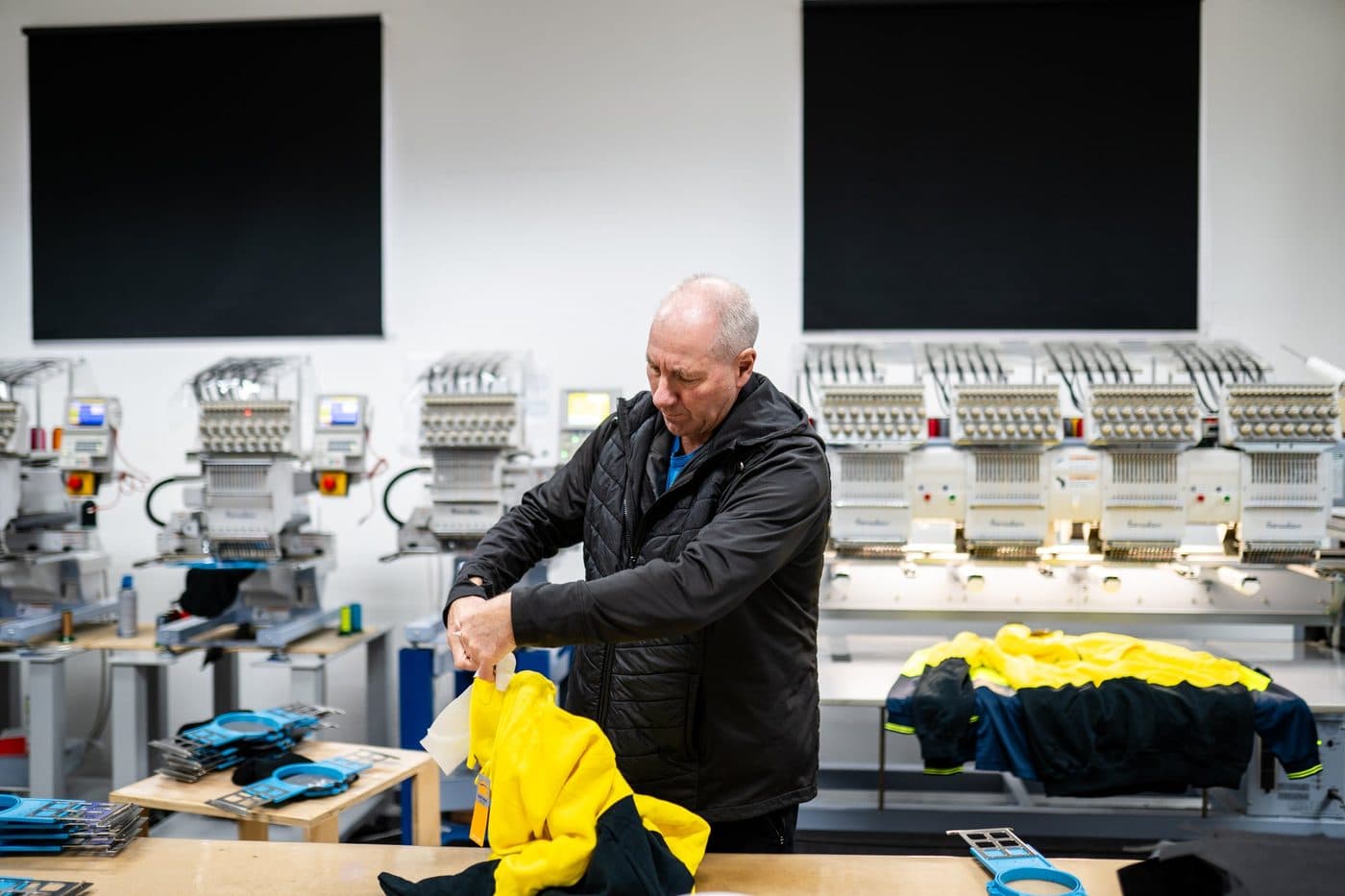
We've been producing embroidery since 2015 and currently operate 8 embroidery machines in our Canberra facility.
Everything is produced in-house, giving us control over the artwork preparation, thread selection, machine setup and finished embroidery.
Whether it's a small chest logo across staff polos or embroidered branding across an entire uniform range, the process starts with translating your artwork into something that can be built with thread.
How embroidery works
From artwork to thread
An embroidery machine doesn't use your normal artwork file directly. First, the design is converted into a specialised stitch file through a process called digitising.
Digitising tells the machine how to construct the artwork: where stitches go, which direction they run, which colours are used and the order different parts of the design are sewn.
The garment is then positioned in the embroidery machine and the design is stitched directly into the fabric.
Artwork
Digitising
Thread colours selected
Garment prepared
Design embroidered
Finished garment
Digitising your artwork
Turning a logo into embroidery
Digitising is more than changing one file format into another. Artwork designed on a screen has to be interpreted as physical thread.
Different parts of the logo may use different types of stitches. Fine details need enough room to remain clear. Larger areas need to be constructed differently from small lettering.
The digitising process works through those decisions and creates the production file used by the embroidery machine.
Once we've created an approved embroidery file for a particular logo and size, we retain it for future orders.
Your artwork shows us the design.
Digitising determines how we build it in thread.
Your artwork
What should I send?
Vector artwork is the best starting point because it gives us clean shapes and edges to work from.
PREFERRED
AI / EPS / SVG / Vector PDF
ALSO USABLE
PNG / JPEG
A clear image can still provide everything needed to create the embroidery file.
Unlike printing, the embroidery machine isn't reproducing the pixels or vectors directly. The supplied artwork is used to create a new stitch-based version of the design.
Send us the best artwork you have and we'll work from there.
Size and detail
What works on screen still has to work in thread
Thread has a physical thickness, so the size of an embroidered design affects how much detail it can hold.
As a logo becomes smaller, fine lines become tighter, small gaps begin to close and very small lettering can become difficult to reproduce clearly.
A bold logo may work extremely well at a small chest size, while more detailed artwork may need slightly more room.
Where required, we can adjust small details, strengthen fine elements or recommend a different embroidery size while keeping the original design recognisable.
Embroidery colours
Matching your branding in thread
Embroidery uses physical thread colours rather than inks.
For brand colours, we select the closest appropriate thread from the available colour range.
Because thread has its own texture and sheen, it interacts with light differently from a printed colour. Even the direction of the stitching can subtly affect how a colour appears.
If colour matching is particularly important, supply your brand colour references with the artwork.
What garments can be embroidered?
Embroidery works across a wide range of garments and is particularly suited to pieces with enough structure to support the stitching.
Polo & business shirts
A classic embroidery application for uniforms, corporate clothing and branded apparel.
Workwear
Work shirts, jackets and vests provide a strong base for embroidered logos and suit the durability of the finish.
Jackets & outerwear
Many softshells, fleece garments, vests and jackets can be embroidered.
Hoodies & crews
Embroidery works well across many heavier cotton and fleece garments.
Caps & headwear
One of the most natural applications for embroidery, including standard and 3D puff finishes.
T-shirts
Smaller embroidery can work well, although the lighter fabric requires more consideration than a polo or jacket.
Sports & performance garments
Many polyester and technical garments can be embroidered with the embroidery prepared around the weight and stretch of the fabric.
The garment matters
The same logo can behave differently on a work jacket, polo and lightweight performance shirt.
Fabric weight, stretch and texture all influence how the embroidery is prepared. The construction of the garment matters too.
Pockets, seams, zippers and linings can affect where the embroidery machine can physically access the garment.
Waterproof and highly technical garments can also require additional consideration because the needle passes directly through the material.
That's why we look at the artwork, garment and position together before production.
Caps & 3D embroidery
Embroidery beyond a standard chest logo
Caps are particularly well suited to embroidery, but their curved and structured shape means they're prepared differently from a flat garment. The cap is held in a specialised frame and the embroidery file is prepared around its shape and construction.
Caps can also be a good application for 3D or puff embroidery. Puff embroidery places foam underneath selected parts of the design before they're stitched, creating a raised three-dimensional finish.
It works particularly well with bold lettering, simple shapes and strong logo elements.
Standard embroidery
Thread stitched directly into the fabric, sitting just above the surface.
3D puff
Foam beneath the stitching lifts selected areas into a raised finish.
Proofing & production
You see it before we run it
Before production, we'll confirm the embroidery at its intended size and position on the garment.
Your proof will show the:
- Artwork
- Embroidery dimensions
- Position
- Garment
- Thread colours
Once approved, the embroidery can move into production.
The stitch file is then retained for future orders, allowing the same embroidery to be reproduced again.
If the application changes significantly - for example, from a small chest logo to a large back embroidery - another stitch file may be required, because embroidery is prepared around its intended size.
Looking after embroidery
Embroidery is extremely durable because the design is physically stitched through the fabric.
For everyday care, follow the washing instructions supplied with the garment itself.
Avoid harsh bleach unless the garment allows it, avoid pulling loose threads and take care when ironing directly over raised embroidery.
Embroidery FAQs
What is embroidery digitising?
Digitising converts normal artwork into the stitch instructions used by an embroidery machine. It determines how the different parts of the design will be physically constructed from thread.
Do I need an embroidery file?
No. Send us your normal artwork and we can create the embroidery file required for production.
What artwork should I send?
Vector artwork such as AI, EPS, SVG or a suitable PDF is preferred, but clear PNG and JPEG files can also be used.
Can you match my brand colours?
Yes. We select the closest appropriate thread colour from the available thread range. Because embroidery uses physical thread rather than mixed ink, an exact printed or Pantone colour may not always have an identical thread equivalent.
How small can embroidered text be?
It depends on the font and design. Bold, open lettering can generally be embroidered smaller than fine lettering with narrow strokes and tight spaces. We assess this at the intended embroidery size.
Can you embroider detailed logos?
Yes, although very fine elements may need to be adjusted depending on the finished size. The important consideration is how the detail translates from digital artwork into physical thread.
Can embroidery reproduce photographs or gradients?
Not in the same way as digital printing. Embroidery can create complex designs and tonal effects, but photographs and smooth digital gradients are generally better suited to a printing method such as DTF.
Can you embroider caps?
Yes. Caps are particularly well suited to embroidery and can also support techniques such as 3D puff embroidery.
Can you embroider T-shirts?
Yes. Smaller embroidery can work well on T-shirts, although their lighter fabric requires more consideration than heavier garments such as polos and jackets.
Can you embroider jackets?
Yes. Many jackets, softshells, fleece garments and vests can be embroidered. The construction, lining, pockets and intended embroidery position are considered before production.
Can you embroider over pockets or seams?
Sometimes. It depends on the garment construction and whether the embroidery machine can access the area correctly. We can assess unusual placements against the garment.
Do I pay for digitising every time?
No. Once an embroidery file has been created for a particular logo and size, we retain it for future orders. A substantially different size or application may require another file.
What is 3D or puff embroidery?
Puff embroidery uses foam underneath selected areas of the design to create a raised, three-dimensional finish. It's particularly suited to bold lettering and simple shapes, especially on caps.
How durable is embroidery?
Embroidery is extremely durable because the design is physically stitched into the fabric rather than applied as a printed layer. With appropriate garment care, it can remain with the garment throughout its usable life.
Is embroidery better than DTF?
They're different finishes. Embroidery gives the design physical texture and dimension and is particularly suited to logos, uniforms, workwear and headwear. DTF can reproduce photographs, complex gradients and very fine full-colour artwork that isn't naturally suited to thread. We'll recommend the method that makes sense for the artwork and garment.
Ready to embroider your garments?
Send us your artwork and the garments you're considering, and we'll work through the size, position, thread colours and embroidery with you.